

Over the course of developing the SPLASH semantic framework (Standard Pattern Language for Advanced Science and Healthcare), I have created a new ontology known as CRO, or Cognitive Reality Ontology. I’ll leave its full explanation for another time, but for our purposes here, part of it is dedicated to information. I provide the overview of this part of the ontology for general interest. The ontological categories described here are used to create more coherent information models for real systems.
1. Information and Meaning
We define information in CRO in a narrow sense as something expressing meaning, and whose receipt has the potential to increase the knowledge of the receiver on some topic or subject of interest.
Meaning is understood in logical terms, i.e. as consisting of propositions and predicates about entities and/or states of affairs either in reality or in any formal space that sits above it. Thus, information may be about (some aspect of) reality, or about a model, a specification, some element of a language or indeed a mathematical proof.
Well constructed information consequently clearly states its referents (targets in reality) and any claims about them, for example that Michael is 55 and has a heart rate of 62 bpm at a certain moment in time. Such statements are therefore testable and provide a basis for determining truth.
The meaning carried in a packet of information is in principal invariant, even though its significance – the knowledge ‘delta’ it conveys to a particular receiver – may be very variable. For example a message indicating that Michael has a resting heart rate of 62 bpm might indicate to Dr Shannon that Michael was or is an athlete.
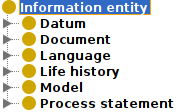
CRO distinguishes all representable kinds of information, primarily on the basis of what they are about, whether it be material reality, a model, a language, or a pure formalism.
The top CRO information classes representing these categories is shown below.
2. What Kinds of Information are there?
One might imagine that information created in social realities can take any form, be about anything, and that consequently there could be no possible approach to ontologising it. However, outside of pure artistic pursuits, in most human disciplines things are surprisingly simple in the abstract, if we view them in an appropriate light.
To provide an initial conceptual structure, CRO makes the assumption that we live and work in technologically enabled, specialised, and institutionally oriented societies, which are heavily dependent on durable information and knowledge accumulated over time. Such descriptions of society may be found in cite:[Luhmann1995SocialSystems], cite:[Luhmann2012TheorySociety1], cite:[Hardwig_1985], cite:[Searle1995ConstructionSocialReality], cite:[Searle2010MakingSocialWorld] and numerous others.
We informally assume that the principal cognitive functions in such societies are likely guides to corresponding ontological categories of information such as:
- describing the world:
- data gathering – fine-grained observations made in the real world;
- describing phenomena – building comprehensive representations of real world entities such as patients, operating machinery, ecosystems;
- knowledge production – creating and documenting categorial knowledge in textbooks, engineering specifications, reports;
- ordaining changes – creating laws, prescribing medicines, legal documents;
- documentation of steps of long-running work processes.
We further assume a meta-level of information artifact types that provide appropriate models and languages of representation for the above.
3. Describing the World
3.1. Individuals
The three sub-categories of ‘describing the world’ above relate to how we obtain and create our knowledge of the world. We initially have to make observations, i.e. obtain data to work with, for which the CRO class Datum is provided. What links a set of ‘data elements’ is _time of sampling, i.e. data items sampled together form a set. A set of data elements is nevertheless an isolated part of the entity being investigated, and doesn’t provide meaning on its own.
We generally have to obtain a sufficiently comprehensive set of data elements to provide an interpretable picture of a complete individual entity, such as the vital signs of a person, or a sales department’s performance. Consider even something as simple as a blood pressure measurement. It is not sufficient to obtain only the systolic and diastolic pressures: a clinician also needs to know the patient position (lying, sitting, standing, inclined), patient exertion (resting, running, post exercise etc.), and if the patient was a child, whether the appropriate cuff size was used. If it is not taken on the brachial artery, the body location may be germane as well. Without this information, the focal data items are not safely interpretable, and are essentially not useful on their own.
To be useful, we need a comprehensive model of entity state at time t. This level of representation is considered a kind of model in CRO, and is addressed with the Physical entity model class and descendants. CRO terms this kind of model in general as ‘meronomic’, i.e. based on recursive representation of parts and sub-parts.
A comprehensive snapshot of entity state at some time t is clearly not a complete picture over time: to truly know what is going on, we need a temporal seris of such snapshots, corresponding to the CRO class Life history that includes multiple snapshots of entity state over time, each of which is an instance of a CRO _Model. The totality of such histories make up a world history, as described in the CRO introduction.
Consider the clinical process around a patient who is eventually diagnosed with cancer. Prior to diagnosis, most of the clinical work is designed to build up a sufficiently complete picture of the patient to document and make sense of the symptoms, make a diagnosis, and embark on treatment. At each point in time, a snapshot of relevant information is captured, resulting in a comprehensive description of the patient, which we may think of as an approximate digital twin. Once the physician makes the diagnosis, and treatment is commenced, maintenance of the digital twin is essential to track patient progress.
The following diagram illustrates the progression from data to life history.

One feature of this diagram not discussed so far is how events are understood in CRO. In some ontologies, ‘event’ is treated as an ontological category, as if what constitutes the event is innate. However, inspection of phenomena commonly referred to as events such as heart attack, migraine, engine failure, earthquake, shows that this is not so, because the boundaries of any such event are observer-dependent. For example one geologist might treat a particular earthquake as just being the major shock, whereas another might consider that slightly earlier shocks, plus a whole series of aftershocks are also part of the event.
Accordingly, CRO treats events as epistemic rather than ontic entities. Their representation is assumed to be some subset of a state history, either between two absolute moments in time, or bracketing a particular sequence of snapshots.
3.2. Population Description
The next level up from description of a single individual, be it a whole patient, a mechanical part of a ship or a complex insurance claim, is that of a cohort or population. A cohort is usually a specific group formed according to some criterion, e.g. type I diabetics, post-menopausal women, aircraft using the Rolls-Royce Trent 900 engine, whereas a population is normally related to geography. For convenience, CRO treats them as being the same thing, since the geography is effectively a criterion.
From a population or cohort, new types of knowledge are available. Statistical analysis produces an overall picture of the group, allowing it to be characterised in specific ways, such as having a high level of obesity, or reacting well to a particular kind of new drug. Correlations are usually extractable. Population information is represented in CRO by the Population twin class, under the Physical entity model class.
Statistical information forms part of the basis for creating new categorial knowledge, e.g. a model of diabetes mellitus type I.

3.3. Categorial Knowledge
We progress from there to categorial knowledge, i.e. knowledge of kinds, or what most people would think of as general knowledge, pedagogical knowledge etc., and which is the basis of any civilisation and its institutions and professions. Creating such knowledge is achieved with methodological modes such as the scientific method, via which we consolidate numerous individual descriptions to create categorial knowledge. For example, medical science has a description of diabetes mellitus constructed by investigation of numerous individual cases of diabetes. Such knowledge is typically documented in academic papers, textbooks and educational course materials. Similarly, by examining thousands of about operational individuals such as sales, contract fulfillment etc., organisations create their own enterprise knowledge, such as the usual working methods, reports, audits and so on.
Categorial knowledge is covered in CRO by the Document class, as well as subclasses of Model, which now describe kinds rather than individuals. Models of the human heart, the Airbus A380 or more generally, ‘monohull sailboat’ are all models of kinds of things.

We may distinguish between descriptions of individuals and knowledge as being used in different ways. The former are used operationally, that is, to perform work on specific cases, such as patients, aircraft, and wineries. Knowledge-level information provides the capability for specialists (doctors, mechanics, etc.) to perform their work in a successful way.
4. Changing the World
The next distinction CRO makes is between describing the world and changing it. Nearly every area of human activity involves at least observation and therefore description. As a consequence, many ontologies stop there.
However, most domains, including medicine, law, engineering, defence and politics also involve brining about change, i.e. intervention. Creating change in social reality can be understood as certain varieties of speech act (in the sense of Searle cite:[Searle_1979]) and document that create obligations on certain parties for the future. For example, a doctor’s prescription creates an obligation for a pharmacy to provide medicine to a patient; an invoice creates an obligation on one party to pay another within a certain time, and on the other to provide the product or service stated.
CRO therefore includes the class Deontic document, a term inspired by Barry Smith’s Document Acts cite:[Smith2014DocumentActs], a synthesis based in turn on the work of Searle and Austin. A Deontic document is understood as a formal bearer of deontic powers between / among agents that creates obligation on some of them. Examples include such things as prescriptions, contracts, powers of attorney, licenses, wills, invoices, and permits.
Deontic documents have the same comprehensiveness requirement, to make them interpretable and therefore actionable. Consider for example the document representing a patient’s chemotherapy plan, such as the UK NHS CHOPS21 regime used over a number of weeks. This also needs to be completed to the point where it can be executed, including calculated dosages, contraindications and allergies, review and approval. Without this, oncology nurses cannot commence administration.
Deontic documents are not the only thing with deontic powers. CRO also assumes that essentially informal statements may be made that have deontic force, such as a team leader’s email to a junior to rerun tests, a request by the CEO to the CFO and so on. These are covered by the CRO Deontic statement category.
5. Predictions
In order to work out what changes to make, an agent typically makes an assessment of risk, in other words, makes predictions of the likely future if no intervention is made, and also with various specific interventions. Detailed predictions may be created with a simulator, such as used for national economies or climate systems, or via statistical means, as is more common in medicine and engineering. In medicine and other domains, a picture of the possible future is often termed a prognosis.
We may visualise prognostic predictions as follows.

No new CRO classes are needed to represent prognostic pathways, since they take the same shape as past history. However, information instances would of course need to be appropriately marked so as not to confuse them with observed true history.
6. Plans
Depending on the complexity of the situation under consideration, intervention may be complex or simple. In most non-trivial cases, some kind of plan is articulated. This may be as simple as a list of proposed actions, such as “Commence antibiotics; introduce probiotics starting day 4; starting day 8, track weight and commence light exercise; …”, or a fully computable plan expressed in a workflow language. The latter is a specific kind of model, covered by CRO Plan, a sub-class of CRO Model.
7. The Cognitive Lifecycle
We may now ask the question: how do descriptions, histories, prognoses, plans, deontic artifacts and so on come into being? CRO makes the assumption that the work to create such informational entities unfolds over time, via an epistemic process consisting of incremental steps, such as a diagnostic pathway, or the workflow to put together a new employment contract. We make this assumption even if the first version of the new artifact is made by copying an existing artifact and subsequently making minor modifications.
Recapitulating the discussion above, we assume that all work processes have the same general structure:
- observations of the real world (evidence);
- assessment of the evidence;
- setting goals;
- a plan of future steps;
- a history of steps performed so far, each consisting of some act such as observation, decision, assessment, ordering etc;
- some indication of status, such as ongoing, complete, abandoned etc.
The following diagram illustrates how work process conceptually fits within the eco-system of information artifact kinds.

Particular processes may differ in the particular types of work, resources and other details, but most goal directed processes include the same kinds of acts, which in the abstract come from some form of the ‘OODA’ model, i.e. observe / orient / decide / act. This is described in detail in the Statement section.
8. Models and Instances
The above categories provide the conceptual distinctions between key kinds of information within the reality of a world. One key feature of reality is the fact that real world individuals of most ontological categories below Physical entity are similar within their particular sub-category, differing only in accidental properties. This is particularly the case for manufactured devices, machines, drugs and so on. In information technology (IT), similarity is captured by the use of models, which are common technical descriptions that leave open accidental details.
For example, descriptions of the same patient vital signs for 10 or 1,000 or a million patients should be the same structures, plus or minus whichever accidental elements are present. Similarly, employment contracts, at least within certain sub-categories, are all the same other than for the individual details, within a given organisation. In general we do not want descriptions, deontic content or investigator statements to each be their own thing, but instead to conform to appropriate natural kinds, i.e. such things as model of blood pressure measurement, plan for chemotherapy administration and so on.
It is for this reason that the Physical entity model class and descendants is used to provide the universals for digital representations of snapshots of not only physical and social individual entities but of common classes, i.e. kinds of device, drug etc.
The Model class has other sub-classes that provide the universals for information models, meta-models and ontologies.