DCM – Data Types and Reference Model considerations

Following the DCM meeting convened by Dr Stan Huff (Intermountain Healthcare) in Washington in July, reported in an earlier blog post, there is a further meeting this week in San Diego, which will discuss the issues of ‘data types’ and ‘reference models’ for the purpose of DCM (detailed clinical models).

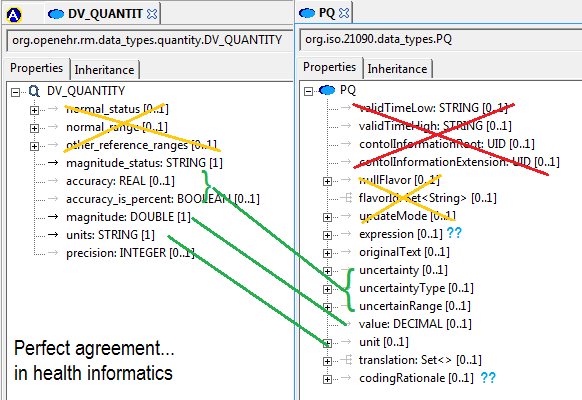
I created two slideshows to explain my views on these matters (DCM_and_data_types and DCM_and_reference_model [both PDF]). Below is an extract of my arguments in these slideshows, based on experience, for adopting a particular approach to data types and reference model within the stated mission the DCM forum, which is to find formalism and attendant models in which to express universally shareable detailed clinical models. Naturally, my view on ‘the answer’ to that question is ‘openEHR (ADL/AOM) archetypes, templates and terminology’, but what I am providing below is not an argument supporting that, but one proposing how to proceed with respect to the ‘underlying models’.
Continue reading

Posted in Health Informatics, openehr | Tagged , , , , , , , | 1 Comment

Why e-health really is hard

Every so often, someone asks: why can’t the health sector get its act together with ICT? Tell me why health is ‘different’?

Dilbert

Dilbert - advances in healthcare

Every so often a new and interesting answer to this question pops up… Continue reading

Posted in Health Informatics, Philosophy | Tagged , | 4 Comments

Information models, DCMs and Archetypes

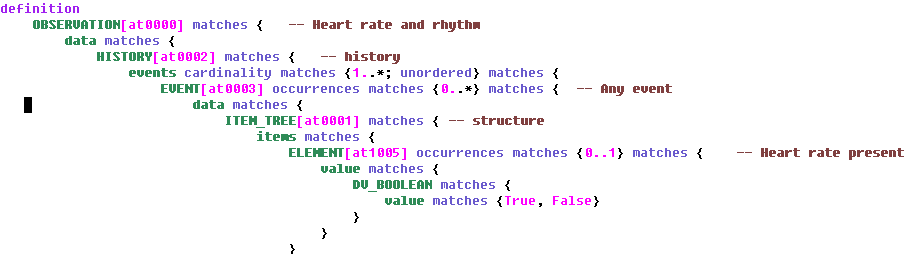
I will be attending a ‘Fresh Look’ meeting in Washington next week. The idea is to make some progress on the topic of  ‘detailed clinical models’ (DCMs). Some of the goals include setting up a repository of DCMs, establishing governance, and defining a roadmap for tooling. Underlying all this is a huge list of formalisms and models, including OWL, UML, ADL, HL7 MIF, XSD, LRA, RMIMs, CDA templates, greenCDA and so on. Continue reading

Posted in Computing, Health Informatics, openehr | Tagged , , , , , | 7 Comments

A reboot for Eiffel, the world’s best programming language?

On 27 June, I ran a workshop at TOOLS 2011 in Zurich, entitled ‘Creating the new Eiffel Technology Community’. I did this at the invitation of Bertrand Meyer, the inventor of Eiffel and also the TOOLS conference programme chair.

Continue reading

Posted in Computing, Culture | 5 Comments

DCMs – can they look good AND be computable?

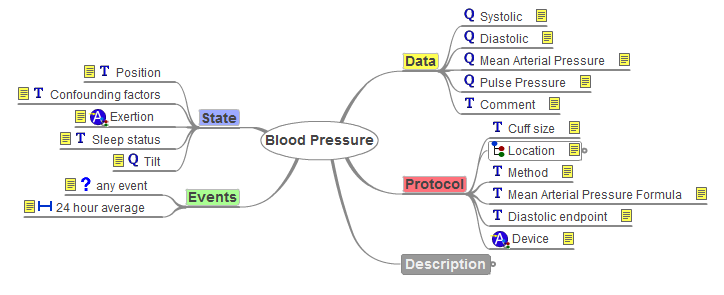
Let’s talk about mindmaps and archetypes. Mindmaps seem to be fuzzy and friendly – we need them because they are incredibly efficient at transmitting information to humans. Archetypes seem über-mathematical, but we need them to do proper model-based computing.

Continue reading

Posted in Computing, Health Informatics, openehr | Tagged , , , , | 1 Comment

Detailed Clinical Models (DCMs) – some basic facts

The New Zealand e-health programme architecture task-force has published its Working Interoperability Reference Architecture blueprint document. With respect to the document and the comments posted (I tried to post myself,  but the comment disappeared), it seems worth making a couple of points on DCMs, of whatever flavour. If a DCM is to be expressed in a way useful to building and managing health IT infrastructure, there are two possibilities. Continue reading

Posted in Health Informatics, openehr | Tagged , , , , , | 5 Comments

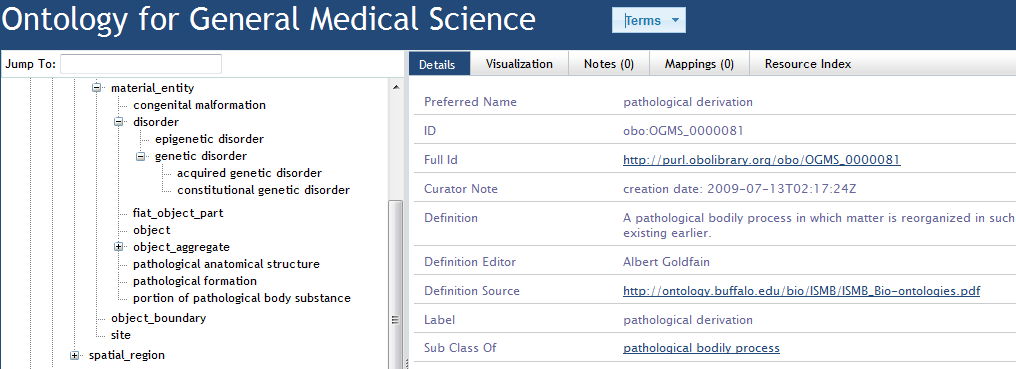
Ontologies and information models: a uniting principle

Software developers and ontologists generally live in two different worlds. The former group think they are building systems to perform information processing and computation, and the latter group think they are formally describing some aspect of the world.

[Note: slight change to wording of FOPP on 30/May/2011]

Continue reading

Posted in Computing, Health Informatics | Tagged , , , | 9 Comments

The HL7 Null Flavor Debate – part 2

Previous: HL7 null flavors part 1

Null flavors – Objection #3: ontological problems

The following table shows the current HL7v3 null flavor values. A full version of the table appears in Grahame Grieve’s blog post. Continue reading

Posted in Computing, Health Informatics, openehr | Tagged , , , , , | 4 Comments

The HL7 Null Flavor Debate – part 1

(With apologies to those who use international English and normally spell it as ‘flavour’; in this post, I will spell it properly in informal text, and in the US way when referring to the formal HL7 null flavour concept.)

Grahame Grieve has pointed out in a recent blog post that I am a major critic of HL7 ‘null flavours’. This is correct, but the reasons are probably misunderstood, so I will try to clarify here. Continue reading

Posted in Computing, Health Informatics, openehr | Tagged , , , , , , | 8 Comments

One information model to rule them all?

One of the age-old debates in health informatics: can there be ‘one information model’ for shared clinical information? Some dream of a model to rule them all, uniting standards efforts, while others dismiss the idea as impossible or unrealistic. Obviously inside deployed health/hospital information (and all other – lab, GP, nursing, billing, PAS etc) products, there are private, differing information models. These do not concern us. Continue reading

Posted in Health Informatics | Tagged , , , | 4 Comments