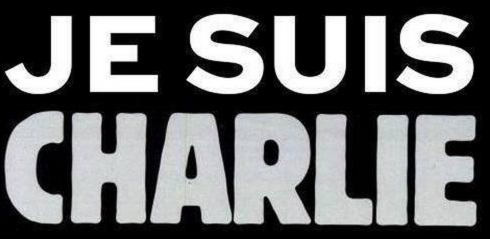
Normally this blog is reserved for my work. This evening I make an exception. I am outraged and disgusted at what I see has happened in Paris this afternoon. A massacre of 12 at and around the offices of Charlie Hebdo, a widely read satirical magazine in France, by Islamist terrorists, apparently in response to a cartoon published recently of the ISIS leader, and no doubt for other perceived slights.
It would be easy to direct our anger at Islam in general, and today I have some sympathy for those who do that. But they are wrong. Not because I think Islam is ‘really peaceful’, and the violent extremists who commit these crimes are ‘not true Muslims’, as various apologists are wont to say. Personally, I think Islam is a pretty useless religion, along with most other religion. The perversion of enforced celibacy and the systemic child abuse – and its systemic denial – of the Catholic church are hardly more defensible than the precepts of Islam commonly targetted by its critics. Some experts’ reading of the ISIS situation concludes that ISIS followers are in fact among the most faithful Muslims, as they (apparently) truly believe they are engaged in holy war in defence of the core values of Islam. However the endless debate about religion isn’t my point for today.
What is important is for all of us who cherish freedom of thought to understand and defend what we think defines a civil society. And one thing I believe defines it is that we do not recognise any ‘right’ to kill in the name of an idea. We particularly do not recognise any right to murder, maim, torture, rape or commit other violence against the person, or against the public in general, based on one’s private or shared beliefs.
We cannot tolerate individuals within our civilised societies who give themselves this right and act upon it. We can only see them as psychopaths and a danger to the rest of us. And today proves that we cannot simply assume that our system of laws and human rights will passively protect us. It won’t. It requires our involvement.
On the other hand, we do recognise the right to freedom of thought and of speech; but this is a right not accepted by the fundamentalists among us, those who arrogate for themselves the right to murder.
We must recognise one thing however. Although in this decade we reel from a seemingly endless barrage of events in which the terrorists are Islamic fundamentalists, history is replete with atrocities committed in the name of ideas, many of them not even religious, let alone Islamic.
The true enemy of any truly just civil society is and has always been absolutists and ideologues. The horrors of the holocaust, Stalin, the killing fields of Cambodia, Uganda and Rwanda are apt reminders that you don’t need religion to commit atrocities. There are those who argue that religion, or some religions, are particularly well-suited to creating and justifying ideological terror, since religion appears to confer divine blessing on the righteous actions of its followers. Although it’s difficult to argue with them (particularly the critique of the idea that ‘all religions are the same’ – they clearly are not), we need to recognise they are talking of religion as ideology, not religion as personal faith.
Let us spare a thought for those who died today at Charlie Hebdo. They were journalists and satirists, just like those you know from TV – Jon Stewart, Ian Hislop, Stephen Colbert, Bill Maher – and those who work for newspapers around the world. Yes they are sometimes tasteless, and even offensive to some. But I find they represent our true thoughts much of the time. They skewer the inflated egos of politicians and demagogues, conservative and radical alike, and help us to laugh (and maybe cry) at some of the outrageous injustices we put up with in our flawed world. But they can only exist within those societies that believe in freedom of thought and speech. Those societies are fundamentally incompatible with the intellectual and physical oppression the violent fundamentalists wish to install.
Today reminds us that we can’t take for granted our right to freedom of thought and speech, nor our rejection of ideological violence. The murdered journalists and cartoonists at Charlie Hebdo were, in their way, fighting for these freedoms, in the same way that Voltaire did in his time – publishing satire and polemic against injustice.