Why using HIT standards fails to achieve interoperability

I started working in the Health IT area in 1994, on a major European Commission funded project. I attended years of standards meetings at HL7, CEN and occasionally OMG and ISO from 1999 to about 2012. And I’ve observed the constant failure of standards (through inappropriate hopes and expectations) to provide anything like a sustainable solution for interoperability. Here are the lessons I draw from this.

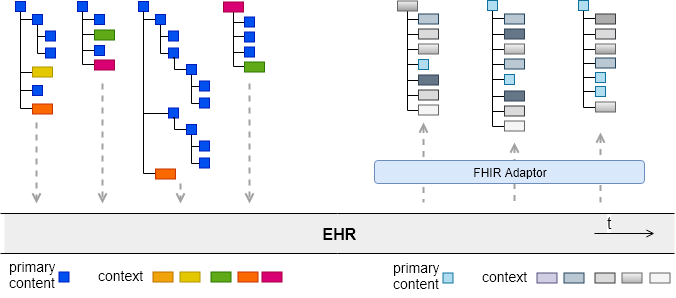
  • Premise #1: interoperability is an outcome, i.e. an emergent quality, not a created input. You can’t achieve true (automatic) interoperability by trying to engineer for it after the creation of the systems you want to interoperate. Why? Because interoperability happens at the touchpoints between parts of a system. To achieve it, you have to have a) knowledge of and ideally b) some say in the architecture of those components – only then will you understand how to create interoperability at the interfaces in question.
  • Premise #2: de jure standards should not be mistaken for architecture. Today’s HIT standards are attempts to engineer post hoc interoperability with no knowledge of the system components – they are essentially various forms of message on the wire. The result is O(10,000) mutually inconsistent interoperability points, not an interoperability-enabled architecture. Bureaucrats routinely mistake standards for architecture, saying things like ‘we must base our system on standards x, y, z’, or ‘we’ll design the system based on standards’. Only do that if you want to repeat the cycle of death.
  • Conclusion #1: any large healthcare delivery organisation or environment has no choice but to define its own architecture, which means thinking about its own data, processes and knowledge assets – in depth. The outline of how interoperability will be achieved at any interface point must be part of that architecture. Only then can any published standard be considered for use, if it truly fits and provides a language of interchange that will be in wide use for the same purpose.
  • Conclusion #2: the only way to engineer standards that will result in sustainable interoperability is to define an open architecture. ‘Standards’ will just be pieces of that specification that apply at interface points.

There is a hidden requirement for success, which is as follows:

  • Requirement: to achieve interoperability, common knowledge resources must be defined and used across the entire domain – i.e. ontologies, terminologies, definitions and models of higher-level artefacts such as data sets and guidelines.

With respect to this point, the Health IT domain has already achieved quite a lot at the terminology level; has good de facto standards for shared data sets (openEHR archetypes, Intermountain Healthcare Clinical Element Models, although the SDOs still struggle with the approach); is only just starting to understand ontology; and is making some initial progress in the process and guideline domain. Most of these are still poorly integrated, but the direction is clear.

The details of how to engineer for sustainable interoperability are mostly outlined in this previous post.

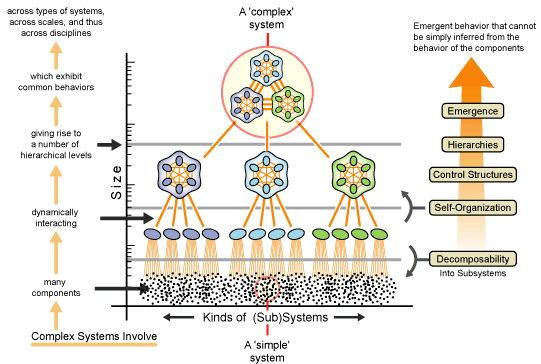
The underlying lesson is to recognise that any environment in which interoperability is desired is a complex system, operating on multiple hierarchical levels, with emergent properties at each. Interoperability is one of those properties.
Posted in Computing, openehr, Philosophy | Tagged , , , , , | 1 Comment

Improving Process State Representation in FHIR

In this post I document further observations on the FHIR resources, made during the transcription of the DSTU4 FHIR resources to the BMM format used in openEHR, as described here. This post examines the definition of process state in FHIR resources.

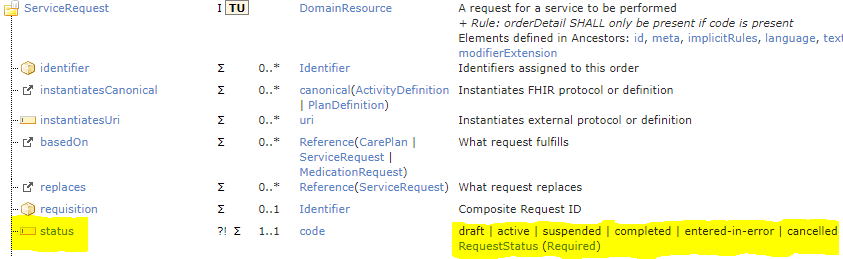
FHIR contains a number of resources that represent workflow actions in healthcare, including ServiceRequest, MedicationRequest, MedicationDispense, Appointment and so on. All of these contain a ‘status’ attribute which is coded with a local code-set representing possible lifecycle states of the action. Here is ServiceRequest:

Continue reading
Posted in FHIR, Health Informatics, openehr, standards | Tagged , , , | Comments Off on Improving Process State Representation in FHIR

FHIR versus the EHR

This image has an empty alt attribute; its file name is fhir_v_the_ehr.png

One of the many things the FHIR silver bullet hype claims FHIR will solve is the EHR, along with Clinical Decision Support (CDS), Care Pathways, and who knows, paving driveways and launching spacecraft. I have made various arguments against silver bullet psychology, which I will not repeat here, but do want to look (again) at the FHIR v EHR question (a previous post on FHIR v openEHR looked at some aspects, and a second at further technical details).

Continue reading
Posted in FHIR, Health Informatics, openehr, standards | Tagged , , , | 1 Comment

A FHIR Experience – the formalism

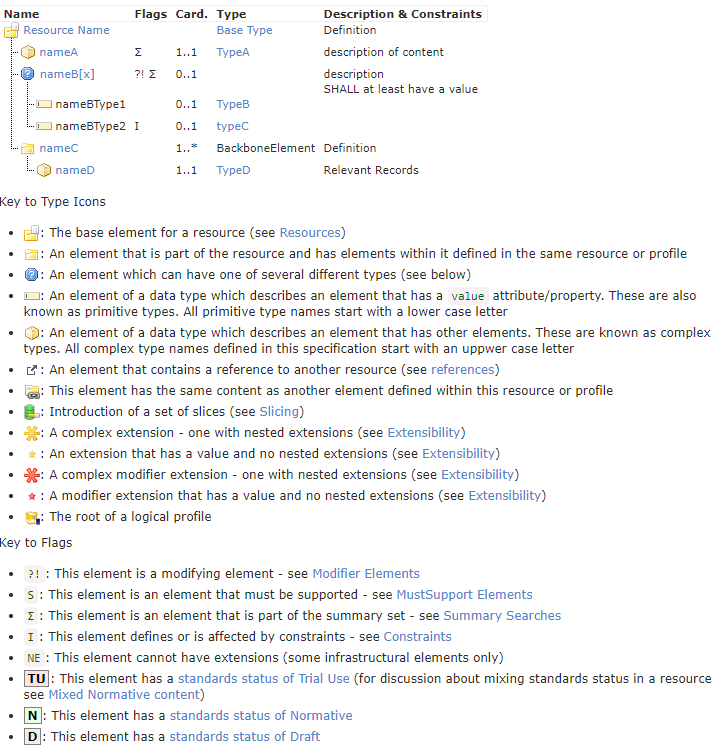
This post continues the review presented in the previous post, where I looked at the Administrative resources of FHIR. Here I take a look at the formalism used in FHIR, i.e. how the resources (and profiles) are formally expressed. FHIR resources are described in terms of a custom formalism expressed as hierarchical tables. The appearance of a resource, along with the elements of the ‘language’ is shown above.

It has to be said in passing that the FHIR website and various visualisations, linking etc is a masterpiece of content-driven presentation.

Continue reading

Posted in FHIR, Health Informatics, standards | Tagged , , , | Comments Off on A FHIR Experience – the formalism

A FHIR experience: models or just definitions?

This is a second instalment of a technical review of the HL7 FHIR resources. As described in the previous post, this review is the result of an element-by-element transcription of the FHIR DSTU4 resources to the openEHR BMM (Basic-meta Model) format for the purpose of model analysis and archetyping. Here I look at the Administrative domain. Continue reading

Posted in FHIR, Health Informatics, standards | Tagged , , | 1 Comment

A FHIR experience: consistently inconsistent

In recent work I am involved in, the HL7 FHIR DSTU4 resources were converted to the openEHR formalism known as Basic Meta-Model (BMM), which is published as an open specification. BMM is an object-oriented formalism, conceptually similar to UML (minus the diagramming), with a fully formal definition. It has been in use since 2009 within the openEHR ADL Workbench, since about 2011 in HL7 CIMI, and since about 2016 in openEHR Archie (ADL2/BMM libraries and tools) and commercial tools including Marand ADL-designer and Veratech LinkEHR.

Continue reading

Posted in FHIR, Health Informatics | Tagged , , | 4 Comments

openEHR Task Planning – a visual model of clinical workflow

We have been making steady progress on the openEHR Task Planning specification and visual modelling language (TP-VML) for clinical workflow. One of the differentiators of Task Planning, is that, like YAWL, it is designed as a formalism for developing fully executable process plans. This means that all the semantics of a TP Plan are formally defined and executable in a TP engine. It also means that the accompanying visual language, TP-VML, consists of visual elements formally related to the TP model. This is in contrast with BPMN, which is defined as a diagramming language with some formal elements mixed in, and other formal requirements expressed separately in the specification. Nonetheless, we are carefully studying the semantics of OMG’s BPMN2 / CMMN / DMN specifications to make sure we cover the necessary requirements, and use the same conceptual terminology as far as possible.

Continue reading
Posted in Computing, Health Informatics, openehr | Tagged , , , , | Comments Off on openEHR Task Planning – a visual model of clinical workflow

Why the NHS needs its own health-tech university

The NHS has around one million employees and serves most people in England and Wales. We could easily imagine a slightly larger organisation serving the whole UK, although for historical reasons Scotland and Northern Ireland are separate. Another large public healthcare organisation is the US Veteran’s Administration, which manages around 160 veterans hospitals and countless clinics in the US. Brazil has an organisation called SUS – the universal healthcare system – which provides public sector care for 160m people not on private care. Smaller countries have similar, generally large, organisations, at least by the standards of each country. Large private organisations such as Kaiser Permanente and Partners Healthcare are in the same position, with the same needs.

There has been an endless search by such organisations over the 25 years I have been involved in e-health for the silver bullet to solve their IT challenge.

Continue reading
Posted in Health Informatics, openehr, standards | Tagged , , , | 4 Comments

The long slow death of UML

The Unified Modelling Language aka UML has been around for 22 years, as you can see from the OMG UML page. We use it extensively to publish the openEHR specifications, in a similar way to many other organisations. Developers often use it for whiteboard brain-storming. But hardly anyone uses it for its original purpose: formal modelling of software leading to code, ideally with round-tripping. And this is despite the availability of excellent UML tools. Architects these days tend to limit their use of UML to package diagrams and a few illustrative class diagrams, while developers tend to go straight to code or use tools that pretty-print extracted textual forms of software such as swagger and apiary.

In openEHR, we publish specifications, so graphical representation of formal models is important. UML is still the only widely used graphical format, so we use it. However, to get around all its problems, I had to develop an alternative for static models, called Basic Meta-Model (BMM), to enable correct formal model representation for our tooling. This was not done lightly – we had to do it because UML does not represent the developer view of models correctly, and that’s the one we want. Worse, its serial form, XMI, is unreliable and unusable by humans or tools other then the creating UML tool. We also developed a UML extractor for the UML tool we use, to fix some of the problems it has, so we know a thing or two about UML under the covers. I have no doubt other organisations have resorted to similar fixes.

A few years ago I asked 8 senior software engineers at a meeting who was using a UML tool in their development work. A total of zero hands went up. And yet humans love pictures, so we should be using some sort of graphical modelling language. What went wrong for UML?

Continue reading
Posted in Computing, Health Informatics, openehr | Tagged , , | 3 Comments

Why NPfIT failed

(from Campion-Awwad, Hayton, Smith and Vuaran, 2014)
Below is my list of reasons why I think NPfIT failed. NPfIT was the NHS National Programme for IT in health, starting in 2002, with Richard Grainger appointed as NHS IT director. A timeline is published here. NPfIT is generally conceded to have spent £10.7bn by the government in 2013, when it was definitively shutdown. Claims have been made that slightly more than this was delivered in value. Realistic analyses such as the one linked to from the image at the top of this post show that the realised benefits are miniscule. Right now, the benefits for ‘Choose and Book’ can probably also be written off, as it is no longer generally used. I would guess the only benefits that those in the industry would agree were actually realised are N3, the secure NHS network and possibly NHS mail. The Spine supplies some benefits, but is so badly designed and over-complicated that it will undoubtedly be completely replaced in the next 5 years. Continue reading
Posted in Health Informatics, openehr, Politics, standards | 8 Comments